Table of Contents
- Why Altberg Boots Suit UK Terrain
- Altberg Boot Fitting Guide: Widths, Sizing and Made to Order
- Best Tactical Boots for UK Terrain: Matching the Model to the Job
- How to Care for Altberg Leather Boots
- Altberg Boots Compared: Key Specifications at a Glance
- Common Mistakes When Buying Altberg Boots
- Frequently Asked Questions
Last Updated: September 25, 2026
Why Altberg Boots Suit UK Terrain
Altberg boots are British-made footwear engineered for the wet, rocky, and unpredictable ground that defines walking conditions across the UK. At Silvermans, we have supplied military and outdoor footwear for more than 75 years, and Altberg remains one of the few makers still building boots on domestic soil with repairable construction.
The brand's reputation rests on three things: a waterproof membrane that keeps water out while letting sweat escape, a Vibram sole for grip on wet rock and mud, and a resoleable design that lets you repair rather than replace.
Altberg Boot Fitting Guide: Widths, Sizing and Made to Order
Altberg boots are fitted by width as well as length, which is why the brand offers multiple width fittings rather than a single standard fit. Getting this right is the single biggest factor in comfort.
Understanding Width Fittings and Footbed Options
- Measure late in the day, when feet are at their largest
- Wear your intended socks during measurement
- Check heel lock, not just toe room
- Consider a made to order build if you fall between widths
Made to order is worth the wait if you have unusual feet or need a specific lacing system configuration. Expect longer lead times. Silvermans can advise on current availability and sizing questions before you commit.
Best Tactical Boots for UK Terrain: Matching the Model to the Job
Matching the model to the job matters more than buying the most expensive pair. A heavy duty patrol boot is wrong for summer lowland walking, and a lightweight suede desert boot is wrong for winter fell. The useful question is not "which is best" but "which sole, upper and support package suits the ground I actually walk on".
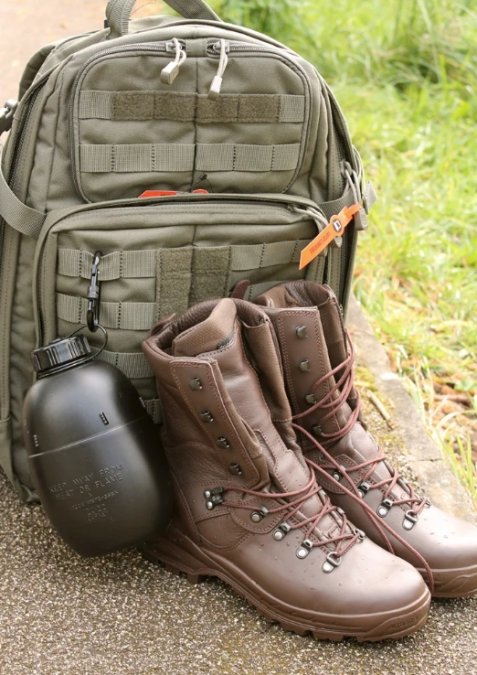
Brown leather Altberg boots standing on wet moorland grass with a rucksack
Match the Boot to the Terrain, Not the Label
Most guides sort boots by "military", "hiking" or "tactical". That tells you who wears them, not whether they will grip. A more useful sort is by ground conditions, because that is what drives sole compound, lug depth, midsole stiffness and upper height.
- Boggy moorland and peat, deep, soft, waterlogged ground. You want aggressive lug depth to shed mud, a stiffer midsole to stop the foot rolling on tussocks, and a full-height leather upper that resists saturation. A soft, shallow-lug sole clogs and then slides.
- Rocky mountain paths and scree, hard, abrasive, uneven. Edge grip and a firmer midsole matter more than lug depth. A softer rubber compound grips wet rock better but wears faster on gritstone; a harder compound lasts longer but feels skittish on wet slabs.
- Wet limestone and paved tracks, the classic lowland and dales mix. You want a sole that stays predictable on wet stone and a boot light enough for long days. Overly stiff mountain boots feel clumsy here.
- Hard surfaces and long shifts, barracks squares, tarmac and concrete. Cushioning and shock absorption dominate; a very stiff mountain sole becomes punishing after several hours.
- Mixed daily wear, a compromise boot with an all-terrain sole and a softer footbed covers more ground acceptably than a specialist boot covers one ground well.
Military, Police and Security Footwear
For service personnel, tactical footwear must handle long shifts, hard surfaces, and sudden weather. Priorities here are ankle support, shock absorbing cushioning, and moisture management. A full grain leather upper resists abrasion better than synthetic alternatives and takes a polish, which matters where kit is inspected.
Hiking, Country and Motorcycle Use
Walkers and trekking users should prioritise traction, a breathable lining, and weight. Country and outdoor footwear leans toward all-terrain soles and a softer footbed for long days. The trade-off is straightforward: lighter and more breathable boots dry faster and tire you less, but a lighter upper flexes more and offers less ankle support on rough ground.
Terrain / Use |
Sole Priority |
Upper Priority |
Support Priority |
|---|---|---|---|
Boggy moorland and peat |
Deep lugs, mud shedding |
Full grain leather, high leg |
Stiff midsole, ankle hold |
Rocky mountain paths |
Edge grip, firm compound |
Abrasion-resistant leather |
Stiff midsole, heel lock |
Wet limestone and tracks |
Predictable wet grip |
Leather/fabric mix |
Moderate, lighter weight |
Hard surfaces, long shifts |
Cushioning, shock absorption |
Full grain leather, polishable |
Ankle support, comfort footbed |
Motorcycle commuting |
Oil-resistant, defined heel |
Treated leather |
Ankle protection, secure lacing |
How to Care for Altberg Leather Boots
Caring for Altberg leather boots comes down to three habits: clean them, treat the leather, and let them dry slowly. Skip any of these and the water repellency fades within a season. The reason is mechanical: mud draws moisture out of leather as it dries, and heat drives the natural oils out faster than they can be replaced, so the upper stiffens and cracks at the flex points.
Cleaning, Leather Treatment and Water Repellency
Start by removing mud with lukewarm water and a soft brush. Never use a radiator or direct heat to dry leather, as it cracks the upper construction.
- Clean after every muddy outing, not once a season
- Apply leather treatment while the boot is still slightly damp
- Re-proof the membrane area with a suitable product
- Store with boot trees or crumpled paper to hold shape
Resoling, Repair and Long-Term Durability
What to check before committing to a repair:
- Midsole compression, if the cushioning layer has flattened or crumbled, it needs replacing alongside the sole
- Upper stitching and flex cracks, small cracks at the toe flex point spread; catching them early keeps repair viable
- Membrane integrity, a boot that leaks through the membrane rather than the leather may not be worth a full rebuild
- Lining wear, a worn heel lining causes blisters even after a perfect resole
If you are unsure whether a pair is worth repairing, ask before you bin them. A quick assessment of the midsole and upper usually gives a clear answer.
Altberg Boots Compared: Key Specifications at a Glance
Altberg boots differ mainly by upper material, sole type, and intended use. The table below summarises the key specifications to compare before buying.
Model Type |
Upper |
Sole |
Best For |
|---|---|---|---|
Military patrol |
Full grain leather |
Vibram, heavy duty |
Service, security |
Hiking |
Leather and fabric |
Vibram, all-terrain |
Trekking, country |
Desert |
Suede |
Lightweight |
Dry, warm conditions |
Motorcycle |
Treated leather |
Oil-resistant |
Road riding |
Common Mistakes When Buying Altberg Boots
Other frequent errors:
- Skipping the width check and ordering standard sizing
- Buying desert boots for wet conditions
- Ignoring care until the leather has already dried out
- Assuming all models share the same sole and support
- Not asking about resoling before the sole wears through
Silvermans stocks many military, tactical, and outdoor footwear and can advise on sizing, care, and model selection. With more than 75 years supplying H.M. forces, we know which boots hold up and which do not.
Frequently Asked Questions
Are Altberg boots worth the money?
Altberg boots are built around full grain leather uppers, a waterproof membrane and a Vibram sole, and many models are resoleable, so the cost is spread over years rather than a single season. If you wear boots daily on rough ground, whether for service, policing or hill walking, the durability and ankle support usually justify the outlay. If you only need occasional light use, a cheaper pair may be enough. Check Silvermans for current pricing and availability.
How should Altberg boots fit?
Altberg boots should feel snug around the heel and midfoot with roughly a thumb's width of space at the toe. Your heel should not lift when you walk. Most models come in several width fittings, so measure both feet and size to the larger one. If you are between sizes or need a custom fit, Altberg's made to order service lets you specify width and footbed. A proper fitting guide from the retailer will help you get this right first time.
Are Altberg boots waterproof?
Most Altberg boots use a waterproof membrane alongside a full grain leather upper, which keeps water out while allowing some breathability. Water repellency fades with use, so regular leather treatment and bootcare products are needed to maintain it. Wet grass and shallow puddles are no problem. Prolonged immersion will eventually overwhelm any membrane, so if you are wading regularly, look for a model designed for that use.
Can Altberg boots be resoled?
Many Altberg models are resoleable, which is one of the main reasons buyers choose them over cheaper tactical footwear. When the Vibram sole wears down, a resole service replaces it and extends the boot's life by years. This matters if you wear boots daily on abrasive ground. Keep the uppers clean and conditioned and the boots can go through several sole replacements before the leather itself needs replacing.
Choosing the right Altberg boots comes down to fit, terrain, and how well you look after them. Silvermans supplies genuine military and outdoor footwear built for real conditions, backed by decades of experience serving professional users. Browse our range, ask us about width fittings and made to order options, and get boots that last through resoling rather than replacement. Get started with Silvermans and gear that performs where it matters.