Table of Contents
- Quick Comparison: Military Backpacks in the Silvermans Range
- How to Choose the Right Military Backpack
- MOLLE Webbing Backpacks: Modular Load Carriage Explained
- Military Daysacks: Lightweight Options for Patrols and EDC
- How to Pack a Military Rucksack for Balance and Access
- Repair, Maintenance and Injury Prevention
- Vintage Surplus vs Modern Tactical Bags
- Conclusion
- Frequently Asked Questions
Last Updated: September 27, 2026
Quick Comparison: Military Backpacks in the Silvermans Range
Choosing military backpacks comes down to capacity, load carriage and build. Silvermans has supplied H.M. forces for over 80 years, and these packs span the full range of military use, from a 35L patrol daysack to genuine vintage webbing pouches.
Pack |
Capacity / Size |
Weight |
Price |
Best For |
|---|---|---|---|---|
35L (52 x 30 x 18 cm) |
Approx. 1.0kg |
£124.99 |
Patrols, trekking, EDC daysack |
|
80 x 35 x 35 cm approx. |
4kg aporox |
£349.00 |
Military Patrols, expedition, trekking, hiking |
|
33-88 litre |
1kg-3kg |
£59.99-£129.99 |
everyday carry, military, trekking, patrols, |
|
55L |
2.4kg |
£160.00 |
Tactical, military, patrol, everyday carry |
How to Choose the Right Military Backpack
Start with the job the pack has to do, not the label on it. A two-day patrol pack and a weekend hill-walk pack have different requirements, and buying for the wrong one is the most common mistake we see.

Capacity, Load Carriage and Frame Types
Capacity is measured in litres, from about 20L for a small daysack to 100L and beyond for a full bergen. The 35LT Berghaus Munro sits in the middle at 35L, the sweet spot for a day's kit or a light overnight.
Material Durability: Cordura, Nylon and Denier Ratings
Cordura is a high-tenacity nylon known for abrasion resistance; the denier rating tells you how heavy the yarn is, so a higher denier means a thicker, tougher fabric.
MOLLE Webbing Backpacks: Modular Load Carriage Explained
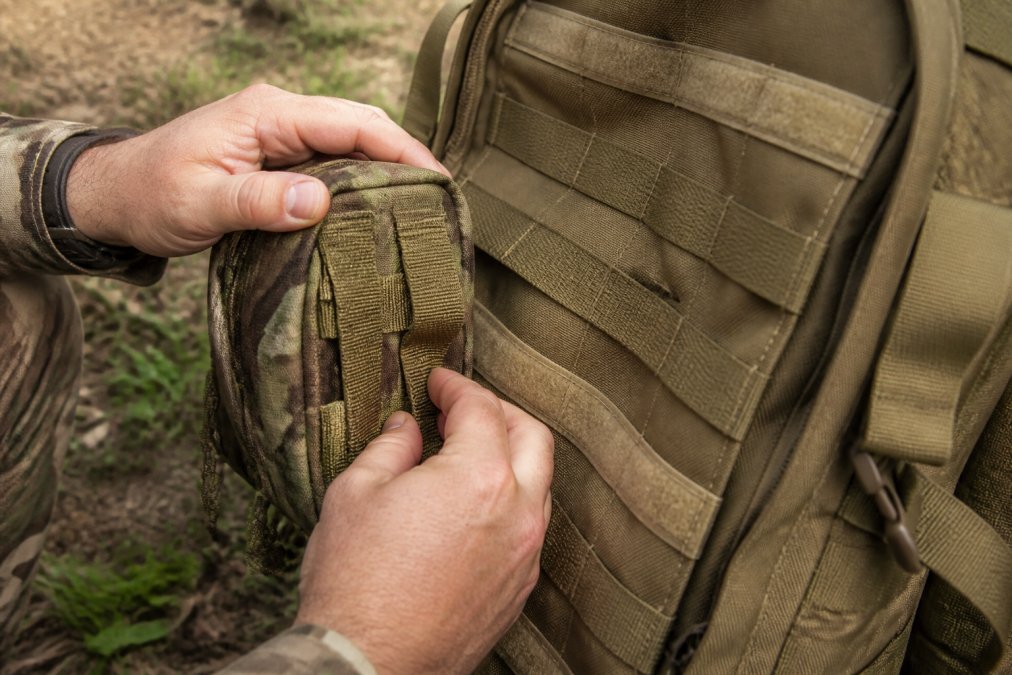
How the PALS Grid Actually Works
Each pouch has vertical straps, or tabs, on its back that are woven horizontally through the PALS rows. The sequence matters:
- Push the pouch strap down through one PALS row and up through the row below it.
- Repeat for each strap on the pouch, keeping them aligned to the same vertical column.
- Thread the strap back through its own buckle or snap, then pull tight.
- Tuck the loose tail behind the webbing so it does not snag.
MOLLE, PALS and Hook-and-Loop: What's the Difference
These terms get used interchangeably, but they are not the same. MOLLE is the overall load-carriage concept; PALS is the webbing grid that makes it work; hook-and-loop (Velcro is a brand name) is a separate fastening method often used alongside PALS for patches, small pouches and admin panels. A pack can have PALS without hook-and-loop, and vice versa.
Load-Out Optimisation: Building Around the Task
Most people go wrong by buying pouches first, then looking for somewhere to put them. Define the task first, then build the minimum load-out that supports it.
- Patrol or day walk (up to 35L): one utility pouch, one water bottle pouch, nothing else on the outside. Keep the profile narrow.
- 72-hour load-out: add a medics pouch, a hydration carrier, and one admin pouch for documents and small kit. Move heavy items to the centre of the main compartment.
- Range or training day: ammo pouches on the belt rather than the pack, so the weight sits on the hips.
Repairing and Replacing MOLLE Webbing
This is the part most buying guides skip, and it is why surplus kit outlasts cheap new kit. PALS webbing is stitched with bar tacks at the ends of each row; if a row comes loose, the fix is straightforward:

- Loose stitching: re-stitch with a heavy-duty nylon thread (a size 69 bonded nylon is typical) using a backstitch, or take it to a canvas repairer. Do not use cotton thread, it rots.
- Broken buckle: most side-release buckles are standard sizes (20mm, 25mm, 38mm). Match the width, thread the webbing through the same way the old one was fitted, and check the ladder lock holds under tension before you load the pouch.
- Worn hook-and-loop: replace the loop panel rather than the whole pouch. A canvas repairer can stitch a new panel over the old one.
- Snapped plastic hardware in cold weather: acetal buckles become brittle below freezing. If you use kit in winter, consider metal replacements at the highest-stress points.
MOLLE is not a decoration. Every row of webbing is a load-bearing attachment point, and every pouch you add is a decision about where the weight sits. Build the load-out for the task, then strip it back down.
Military Daysacks: Lightweight Options for Patrols and EDC
A daysack is the pack you carry when you do not need a full bergen. It holds a day's essentials: water, food, a spare layer and personal kit.
How to Pack a Military Rucksack for Balance and Access
Packing a rucksack is a weight-distribution exercise, not a stuffing exercise. Get the order right and the same load feels lighter. Get it wrong and a 15kg pack feels like 25kg by the second hour.
The Weight-Distribution Principle
- Heavy items high and close to your spine. This keeps the weight over your hips and stops the pack pulling you backwards. On a 35L daysack, that usually means water, tools or a stove sitting against your back at shoulder-blade height.
- Medium-weight items at the base. They act as a platform and keep the pack sitting upright.
- Light items at the top and in the lid pocket. The Munro has a top lid pocket for exactly this, spare layer, snacks, headtorch.
- Items you need often on the outside. Water, a map, or a canteen go on an attachment point, not at the bottom of the main compartment.
- Compression straps last. Tighten them to stop the load shifting as you walk. A pack that shifts is a pack that rubs.
Compartmentalisation makes this work. The PLCE Medics Pouch uses two removable olive mesh bags so you can separate a medical kit and pull it out fast, a principle that applies to any load: group items by function, not size.
Scenario Load-Outs: What Actually Goes In
Generic packing advice is easy; specific load-outs are what people search for. Here are three covering most use cases.
Daily commute or EDC (20-35L)
35LT BERGHAUS MUNRO RUCKSACK →
- Laptop or tablet in a padded sleeve against the back panel
- Spare layer in the main compartment, mid-height
- Water bottle in a side pouch or PALS-mounted carrier
- Small admin pouch in the lid for keys, cards, cables
- Nothing on the outside that snags on public transport
72-hour load-out (35-50L)
- Sleeping bag or bivvy at the base (light, bulky)
- Spare clothing and food in the middle
- Water, stove and tools high and close to the spine
- Medics pouch on the side PALS, accessible without unpacking
- Hydration bladder in the dedicated sleeve, tube routed over the shoulder
- Documents and cash in a waterproof pouch in the lid Securing the base of your pack requires high quality sleeping bags that compress efficiently without compromising thermal performance during extended field operations.
Patrol or range day (25-35L)
- Ammo or utility pouches on the belt, not the pack, so weight sits on the hips
- Water on the side, accessible on the move
- Wet-weather layer in the top of the main compartment
- Nothing loose, every strap tucked, every buckle fastened
Fitting the Pack to Prevent Injury
The waist belt is not optional. Carrying weight on the shoulders alone loads the neck and upper back. A common pattern among physios and outdoor instructors is to fit a loaded pack in this order:
- Loosen everything. Shoulder straps, waist belt, sternum strap, load-lifter straps.
- Fasten the waist belt first, centred on the hip bones, and tighten until the pack's weight sits on the hips rather than the shoulders.
- Tighten the shoulder straps until they sit flat against your back, not digging into the collarbone.
- Fasten the sternum strap across the chest, at a height that does not restrict breathing.
- Adjust the load-lifter straps (the small straps at the top of the shoulder straps) to pull the pack closer to your back.
The single biggest cause of pack-related discomfort is a waist belt left undone. Weight on the hips is weight your shoulders are not carrying.
Repair, Maintenance and Injury Prevention
Military kit lasts decades if you look after it, and most failures we see are preventable. This is the part most buying guides skip.
- Clean canvas and webbing with a soft brush and plain water. Detergents strip water-repellent coatings.
- Dry packs out of direct heat. Radiators and direct sun crack coatings and weaken stitching.
- Check stitching at stress points. Shoulder strap anchors, waist belt junctions and zip ends take the most load.
- Re-proof water-repellent finishes periodically. A spray-on treatment restores the beading that sheds rain.
- Store packs loosely, not compressed. Long-term compression weakens foam padding.
The single biggest cause of pack-related discomfort is a waist belt left undone. Weight on the hips is weight your shoulders are not carrying.
Vintage Surplus vs Modern Tactical Bags
Vintage surplus and modern tactical bags solve different problems. Vintage kit is built from canvas webbing and heavy materials, often to a standard that has not been matched since. Modern kit is lighter, uses Cordura and ripstop nylon, and is designed around modular systems.
Conclusion
The right military backpack is the one matched to your load, your frame and your task, not the one with the highest litre count. Start with capacity and load carriage, check the material and denier, then build a modular load-out you have actually tested on the move.
Frequently Asked Questions
What brand of backpack does the military use?
Armed forces issue kit through official supply chains, but the commercial market offers equivalent or better options. The Berghaus Munro, for example, is built to military specification and widely used by service personnel. Look for packs with durable materials, a supportive frame and compatibility with modular systems. Silvermans has supplied H.M. forces for over 75 years, so their range reflects what actually works in the field.
What is the best military backpack in the UK?
The best pack depends on your role and load. For a versatile daysack, the 35LT Berghaus Munro Rucksack at £124.99 offers a 35-litre capacity, internal frame and abrasion-resistant fabric. For heavier loads or modular setups, a larger bergen with MOLLE webbing may suit better. Consider capacity, frame type and whether you need PALS grid attachment points. Silvermans stocks genuine military-grade options rather than fashion copies.
What are the benefits of MOLLE webbing on a backpack?
MOLLE webbing, combined with a PALS grid, lets you attach pouches, hydration bladders and other kit without permanent modifications. This modularity means you can scale your load up or down for different tasks. It also allows quick-release access to essentials. For military personnel, that flexibility is vital. For civilians, it means one pack can serve multiple roles, from trekking to everyday carry, without buying separate bags.
How do I choose the right capacity for a tactical rucksack?
Capacity depends on mission length and kit volume. A 30-40 litre daysack suits day patrols or EDC. For 24-48 hours, look at 50-70 litres. Beyond that, a bergen of 80 litres or more may be needed. The 35LT Berghaus Munro is a strong 35-litre option. Always try packing your actual kit before buying; a pack that is too large encourages overloading, while one too small forces compromises.
Are military surplus backpacks better than modern tactical bags?
Neither is universally better. Surplus packs like the Royal Signals Shoulder Satchel are built from heavy-duty canvas webbing that can last decades, but they may lack modern features like hydration compatibility. Modern tactical bags often use lighter materials and MOLLE systems. Your choice should hinge on condition, intended use and whether you value authenticity or contemporary functionality. Silvermans grades surplus accurately so you know what you are getting.